Friday, 27 May 2011

REVIEW "So ein Wahnsinn - Horst Ademeit in Berlin" in FAZ 27.05.2011


Horst Ademeit in Berlin

So ein Wahnsinn

Horst Ademeit war besessen von der Idee einer gefährlichen Kältestrahlung. In mehr als sechstausend Polaroids aus dem Alltag wollte er diese Gefahr dokumentieren. Zeigt sich darin mehr sehen als nur seine Obsession?

Von Niklas Maak, Berlin

"Wenn man es sieht, glaubt man es nicht: Über sechstausend Polaroidfotos, aufgenommen über einen Zeitraum von mehreren Jahrzehnten, minutiös durchnummeriert. Man sieht Zeitungen, Eisenteile, Stromzähler, Elektrokabel, Fahrräder, Alltagsdinge. Im weißen Rahmen, der ein Polaroid umgibt, hat jemand mit einem mikroskopisch feinen Stift ganze Romane notiert - pro Foto findet sich oft der Gegenwert von fünf engbedruckten Seiten: Fakten, Theorien, Anmerkungen, ein arabesker Irrgarten aus schwer zu entziffernden Worten.

Horst Ademeit hat 1989 begonnen, auf Polaroids Dinge in seiner Umgebung zu dokumentieren; er war besessen von der Idee, dass von bestimmten Dingen eine „Kältestrahlung“ ausgehe, die ihm schade. So entstand über die Jahre ein Konvolut, das wie ein streng konzeptionelles Kunstwerk wirkt, der Bilderatlas einer privaten Obsession, dem auf engstem Raum ein obsessiver Roman eingeschrieben ist. Wenn man weiß, dass es Ademeit darum ging, bedrohliche Strahlungen sichtbar zu machen, bekommen die Dinge, die man sieht, etwas Unheilvolles: Das Auto schaut böse, das Kabel sieht nach Verhängnis aus (...)"

Klicken Sie hier um den FAZ- Artikel vollständig weiterzulesen.

Niklaas Maak: "So ein Wahnsinn - Horst Ademeit im Hamburger Bahnhof in Berlin" in Frankfurter Allgemeine Zeitung, S.36, Nr. 123 (27.05.2011)

Online abrufbar hier.

Wednesday, 11 May 2011

EXHIBITION Horst Ademeit at Hamburger Bahnhof - Museum for Contemporary Art, Berlin


secret universe:
HORST ADEMEIT

13.05 - 25.09.2011
opening: 12.05, 8 pm

With the exhibition series secret universe, the Hamburger Bahnhof - Museum for Contemporary Art inaugurates a project space, which presents singular artistic positions that go beyond categorization in terms of current art keywords, but which nevertheless revert to common strategies of contemporary art. secret universe offers insight into fascinatingly coherent worlds and complex, visual narrative spaces of hitherto largely neglected artistic positions. Some of the artists presented are denominated as "outsiders"; their work cannot be clearly integrated into the art establishment. secret universe introduces these positions of astounding visual intensity beyond the clear demarcation of "inside" and "outside," revealing idiosyncratic and autonomous approaches with a potential of breaking down the discourse of art criticism and the cultural establishment.


The first exhibition of the secret universe series presents the photographic oeuvre of Horst Ademeit. Over a period of over twenty years Ademeit compiled an archive comprising thousands of Polaroid images. In two groups of parallel works - observation images and diary images - he meticulously documented the impact of radiation on his surroundings, particularly the influence of cold rays. Making use of scientific measuring methods, he encompasses the formal canon of 20th century art, ranging from street photography to conceptual art.

Born in Cologne in 1937, Horst Ademeit completed an apprenticeship as a house painter and then went on to study Textile Design before attending the Kölner Werkkunstschule. In 1970, he was briefly enrolled in the class of Joseph Beuys at the Kunstakademie Düsseldorf. After a first series of documentary photographs, which depicted renovation works in dilapidated buildings, he turned increasingly to the documentation of radiation in the late 1980s. His body of work was discovered only two years prior to his death. Although originally pushed by personal motivation, Ademeit actively supported the late recognition of his work within the context of the art establishment. The National Gallery at the Hamburger Bahnhof dedicates Ademeit the first museum exhibition.


Horst Ademeit's oeuvre questions the interplay between autonomous artistic production, public awareness and art evaluation in terms of its theoretical and critical context. The secret universe series, curated by Claudia Dichter and developed with the assistance of Susanne Zander, raises these questions in regard to concepts of disposition for collections and temporary exhibitions, abandoning common practice in favour of opening the museum space to a long-term debate.


The series secret universe was made possible by the About Change, Stiftung.

All works on display have been loans from Galerie Susanne Zander.


www.hamburgerbahnhof.de


Thursday, 5 May 2011

EXHIBITION
10th Anniversary of the Prinzhorn Collection

Richard Lindner, Woman with a Whip, 1977


FROM KIRCHNER TILL THIS DAY

Artist Reaction of the Prinzhorn Collection


7th May - 14th August 2011

opening: 6th May 2011, 5.30 pm


In 2001, the Museum Prinzhorn Collection opened in a refurbished lecture building. It celebrates its 10th anniversary with an extensive exhibition on the resonance of its collection, in which several Heidelberg institutions participate. With works by more than 60 artists, it shows the differences in the critical responses to the famous collection, from Prinzhorn’s time until the present.


In the Prinzhorn Collection Museum, works from the historic fund are mainly juxtaposed with works by more senior artists. The Expressionists Ernst Ludwig Kirchner and Alfred Kubin are represented, as well as Paul Klee and the Surrealist Max Ernst. The post 1945 response is shown in works by more contemporary ‘classic’ figures like Richard Lindner, Georg Baselitz, Walter Stöhrer, Arnulf Rainer, Wolfgang Petrick, Emil Siemeister, and Edgar Schmandt, but also by younger artists like Lisa Niederreiter and Jennifer Gilbert. The cabinets contain different responses to textile works like the little jacket by Agnes Richter and to the iconic drawings of August Natterer. The Public Library presents in its foyer and reading area an installation by Peter Riek; the DAI exhibition space shows unexpected views on and into the museum by the photographer Jochen Steinmetz. The Museum Haus Cajeth sees an encounter of several draughtsmen and women: Jörg Ahrnt, Julia Kuhl, Stefan Lausch, and Dorothee Rocke. And the Heidelberger Forum für Kunst brings together the responses of 27 artists of the BBK.
Thus the exhibition gives an overview of art in the 20th and 21st century from an eccentric but revealing perspective.


Museum Sammlung Prinzhorn


Klinik für Allgemeine Psychiatrie

Universitätsklinik Heidelberg


Voßstraße 2


D-69115 Heidelberg


www.prinzhorn.ukl-hd.de


Tuesday, 3 May 2011

EXHIBITION Tichý at WILKINSON, London


MIROSLAV TICHÝ
5 May to 5 June 2011

Wilkinson Gallery, London

in collaboration with Galerie Susanne Zander, Cologne


Miroslav Tichý began taking photographs in the 1960s, continuing until the late 1980s, accumulating an expansive archive of images. Tichý originally studied painting at the Academy of Fine Arts in Prague, where he was an esteemed painter and draughtsman, taking a lively modernist approach to his artwork. In 1948, with the adoption of communism in Czechoslovakia, artists were enforced to produce work in the socialist realism manner, which Tichý determinedly rejected. In opposition, he and like-minded alumni formed an artist collective, the Brněnská Pětka (Brno Five), staging subversive exhibitions, which attracted continuous state surveillance. In 1957, the artist suffered a mental collapse - he was prone to psychological breakdowns from a young age - and this led to his removal from mainstream society, moving back to his small hometown, Kyjov. He became a non-conformist, eccentric character, half-conscious, half-delusional to his subversive outsider situation.

The artist devotedly wandered the streets, compiling a meticulous photographic archive of Kyjov. He mainly photographed the local women; the curvaceous contours of a body in motion, captured moments of sartorial revelation, smooth calves truncating from underneath full skirts, and remote utterances muttered between intimate sororities. He honoured women in bikinis, becoming a regular of the periphery of the local swimming pool, photographing from the other side of the fence, the metal mesh dissecting the surface of his images. He worked with a homemade camera that he fashioned from used materials, such as shoeboxes, rubber bands and tin cans, complete with makeshift telephoto lenses, polished with toothpaste and ashes. Tichý would then print on a homemade enlarger. He would subsequently adorn certain prints with pencil marks, highlighting the contours of a form, or decorating the edges with coloured cardboard borders, until the works were spilled scatteringly onto the floor, some used as beer mats, some nibbled by rats.

Tichý was an unobserved observer. His approach follows in the tradition of street photography; individuals roaming with lightweight cameras, shooting unsuspecting subjects, recording private moments occurring in public spaces. His photographs present the potential voyeuristic nature of the camera. His continuous contemplation of the female form refers his work to the tradition of high art, where the female nude is seen as the visual culmination of aesthetics. Tichý both celebrates and subverts the pictorial tradition of the nude. The soft focus, careful observation and caressing light provide the photographs with a painterly quality. Yet simultaneously their haphazard compositions and degraded surfaces distort the female form, reminding the viewer of family snapshots. Tichý reveals that the female nude can easily cross the thin line between nudity and nakidity, eroticism and illicitness, spilling into the realm of the pornographic. The ideology of realism, which imbues the photographic image, results in the increased sexualisation of the depicted body, reinforced by the tactile, fetishistic qualities latent in a photograph, diminishing the proximity between subject and viewer.

Tichý was fulfilling a scopophilic urge, whilst fuelling a subversive protest against the Soviet-satellite regime. His move from painting to photography permitted a continued individual artistic endeavour. Photography was less threatening to the Czech authorities than abstract painting. It was dismissible as an innocuous form of amateur documentation. Tichy positioned himself as the town eccentric, and as an outsider he was able to withdraw into the background, his ensuing invisibility providing him with the freedom to assume the role of an observer. His anonymity was an act of political and artistic intent.

The artist’s compulsive collecting of images mimicked the Czech government’s extensive surveillance regime. His archiving acted as a parody of the state’s obsessive observation, carried out with a seemingly inadequate caricature of a camera. The mechanism’s simplicity of conviction and the irreverence, with which he treated his images, becomes a satire of the inherent complexity and futility of a large government surveillance regime. Tichý was a dissident spy, persistently surveyed and incessantly surveying.

Tichý’s experience parallels the heightened state of surveillance and voyeurism that characterises our modern society. The exhibitionism we encounter in these photographs is now a constant impulse, in an age dominated by the accessible and intrusive nature of the Internet and CCTV. The difference between Tichý’s photographs and the plethora of images today, are that his photographs were not intended for public dissemination, but were driven by a private desire for visual and dissident pleasure. The aesthetic of Tichý’s photographs clash with the unsoiled lucidity of digital imagery, his photographs have been touched, not retouched. The grainy quality, the curled edges, the pencil marks, and the yellowing paper all characterise these images. They are structured by their limitations and their imperfections, and above all the presence of the artist himself. His circumstances, his persona and his idiosyncratic approach to photography all mark the final physical object, visually manifesting the reveries of a peeping dissident.

Miroslav Tichý’s photographs have only come to the public attention in the last seven years; inaugurated by his inclusion in the 2004 Seville Biennial, by eminent curator Harald Szeemann. Since 2004 several major international venues have mounted exhibitions, including the Centre Pompidou, Paris (2008) and International Centre of Photography, New York (2010).

Miroslav Tichý died on 12 April 2011, aged 85.

This show was organized in collaboration with Galerie Susanne Zander, Cologne.


All installation views of the Wilkinson Gallery by Peter White

www.wilkinsongallery.com
www.galerie-susanne-zander.com

Saturday, 16 April 2011

Miroslav Tichý dies at age 85


Miroslav Tichý (November 20, 1926 – April 12, 2011) was a photographer who from the 1960s to 1985 took thousands of surreptitious pictures of women in his hometown of Kyjov in the Chech Republic, using homemade cameras constructed of cardboard tubes, tin cans and other at-hand materials. Most of his subjects were unaware they are being photographed. A few struck beauty-pageant poses when they sighted him, perhaps not realizing that the parody of a camera he carried was real. His soft focus, fleeting glimpses of the women of Kyjov are skewed, spotted and badly printed — flawed by the limitations of his primitive equipment and a series of deliberate processing mistakes meant to add poetic imperfections. Of his technical methods, he has said, "First of all, you have to have a bad camera", and, "If you want to be famous, you must do something more badly than anybody in the entire world."
During the Communist regime in Czechoslovakia, Tichý was considered a dissident and badly treated. His photographs remained largely unknown until an exhibition was held for him in 2004. Tichý did not attend exhibitions, and lived a life of self-sufficiency and freedom from the standards of society.

Tichý died last Tuesday. April 12th, 2011 in Kyjov.

Miroslav Tichý was represented by Galerie Susanne Zander.
www.galerie-susanne-zander.com

Tuesday, 12 April 2011

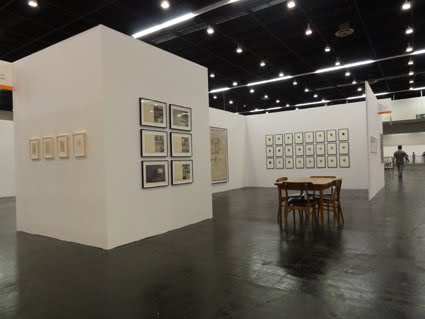
ART FAIRS Galerie Susanne Zander @ ART COLOGNE 2011


Galerie Susanne Zander presents:

George Widener
Chris Hipkiss
Miroslav Tichy
Horst Ademeit
Aurel Iselstöger


Visit us in hall 11.3 - booth C40


opening: April 12th, 5 - 9 pm

13-16 April 2011: daily from 12 a.m. to 8 p.m.
17 April 2011: from 12 a.m. to 6 p.m.

www.artcologne.com

Tuesday, 5 April 2011

EXHIBITION Tichy at the gallery of the Braunschweig University of Arts


Photographs and Illustrations

13th April - 13th Mai 2011

opening: April 12, 2011, 7 pm


Miroslav Tichý himself never cared to be in the limelight, he sought neither to be exhibited nor to be published. It simply did not seem desirable to him. He repeatedly declared that the world was a mere pretense, an illusion, in which we perceive only that what we want to perceive

In the late 1940s, following his training at the Prague Academy of Fine Arts, Tichý started out as a painter and illustrator. However, the totalitarian conditions surrounding him paired with personal experiences meant that he increasingly alienated himself from the official art and cultural scene. Eventually, Tichý withdrew completely from the public eye and one day began to take photographs.

As time went on, he increasingly neglected his appearance, growing a beard, leaving his hair long and matted, his clothes mere rags. Children were mostly afraid of him to start with. They believed that his photographic equipment was fake and that, in reality, he was not a photographer at all. His apartment had the look and feel of a crazy inventor’s workshop. There was no heating, meaning that the winters were damp and cold. There were pictures, illustrations and photographs strewn about the floor, collecting mold. But this was not important to him. Tichý who was born in a small village in Moravia on November 20, 1926 has today grown to be more amicable; he no longer scares curious visitors away with a battleaxe. He stopped taking pictures in the early 1990s. The ball got rolling several years ago when the nephew of an old friend convinced him to hold his first exhibition and Harald Szeemann presented him at the 2004 Bienal Internacional de Arte Contemporaneo in Seville. The world has taken an interest in the old “Samurai” ever since.


Welcoming address:
Prof. Dr. Hubertus v. Amelunxen, President of the Braunschweig University of Art
Introduction: Prof. Dr. Andreas Bee, Curator of the exhibition


Mon–Fri 1–6 pm, Thu 1–8 pm
Closed on public holidays

Hochschule fuer Bildende Kuenste Braunschweig/Braunschweig University of Art
Johannes-Selenka-Platz 1
38118 Braunschweig Germany.

www.hbk-bs.de/en/aktuell